Picking the right SEO software used to mean comparing keyword databases and backlink counts. That’s no longer enough. In 2026, the best AI SEO tools do far more than track rankings on Google. They help you write content that scores well, spot technical problems before they hurt traffic, and even monitor how your brand shows up inside ChatGPT, Perplexity, and Google’s AI Overviews.
This shift matters because search itself has changed. People still type queries into Google, but they also ask questions directly to AI chatbots. If your content isn’t structured for both worlds, you’re leaving traffic on the table.
This guide breaks down the top AI-powered SEO platforms available right now. You’ll get real pricing, honest pros and cons, and a clear recommendation based on your team size and budget. No fluff, no recycled “top 10” filler — just what actually works.
What Makes an SEO Tool “AI-Powered” in 2026
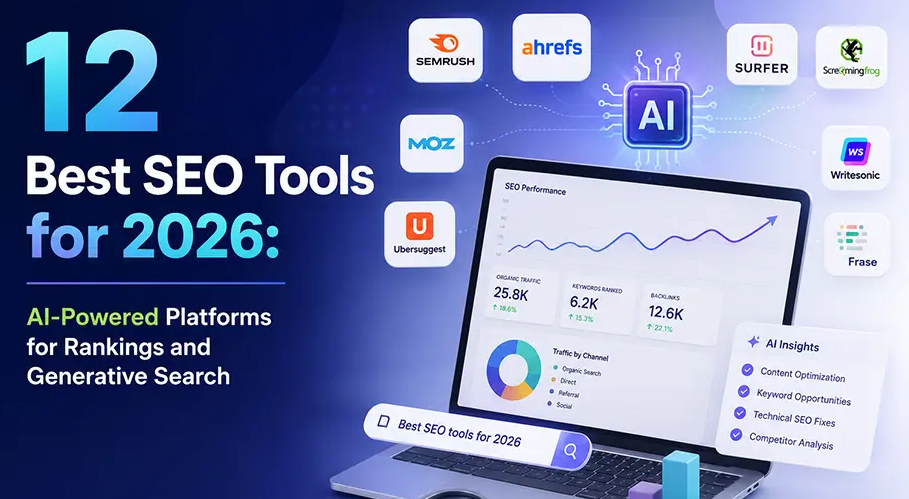
Not every tool that slaps “AI” on its homepage deserves the label. A genuinely AI-powered SEO platform typically does one or more of these things well:
- Analyzes top-ranking pages automatically and turns that data into a content brief.
- Scores your draft against competitors in real time as you write.
- Tracks brand visibility inside AI answer engines like ChatGPT, Gemini, and Perplexity — often called Generative Engine Optimization (GEO).
- Automates technical audits, flagging crawl errors, missing metadata, or slow pages without manual review.
- Generates first drafts using large language models, then layers optimization scoring on top.
The industry has also split into two distinct disciplines that often get lumped together. Traditional AI-assisted SEO focuses on writing and optimizing content faster. GEO focuses on making sure your brand gets cited when someone asks an AI chatbot a question instead of typing it into Google. The strongest tools on this list address both, though most still specialize in one.
How We Evaluated These Tools
Rather than ranking tools by popularity, this guide weighs four factors that actually affect results:
- Accuracy of AI-generated recommendations compared against real ranking data.
- Price-to-value ratio for solo creators, small teams, and agencies.
- Breadth of AI search tracking, since GEO visibility is becoming a standard expectation.
- Ease of adoption, because a powerful tool your team won’t use isn’t actually powerful.
The Best AI SEO Tools Compared
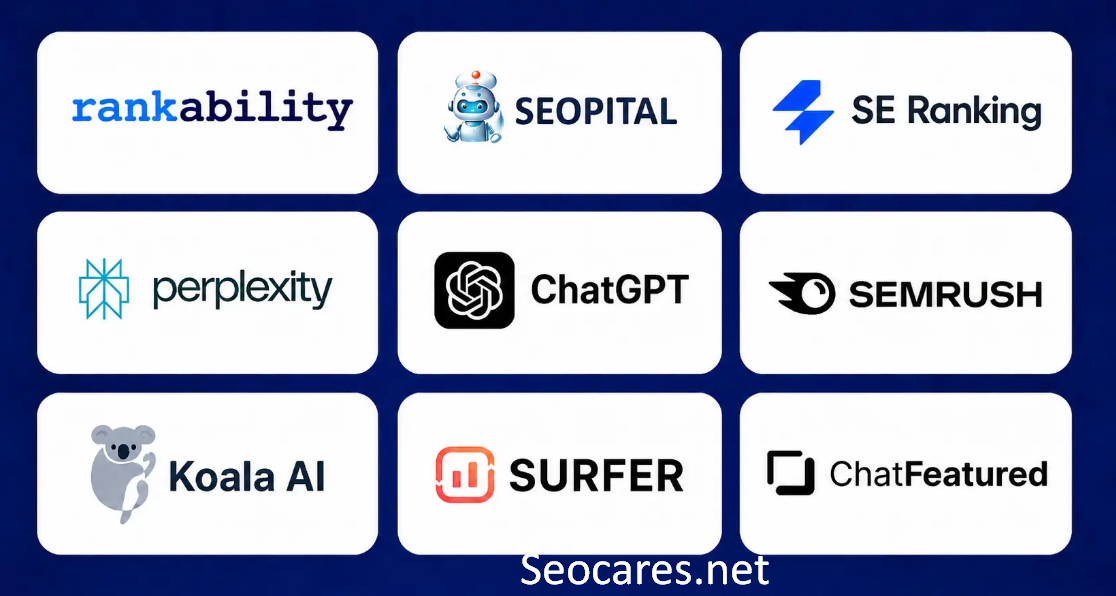
1. Best All-in-One Platform: Semrush
Semrush remains the safest pick for teams that want one platform to run their entire SEO program. It bundles keyword research, technical site audits, backlink analysis, competitor tracking, and AI-assisted content optimization into a single dashboard.
Its Competitive Intelligence module stands out because it shows organic and paid traffic data side by side — something most dedicated content tools simply don’t offer. Semrush also tracks AI visibility across platforms like ChatGPT and Google AI Mode, so you’re not stuck buying a separate GEO tool right away.
Best for: Agencies and businesses that want research, audits, and content optimization under one login instead of juggling five subscriptions.
Starting price: Plans typically begin around $140/month for the Pro tier, with content optimization features usually gated to higher tiers.
2. Best for Content Optimization: Surfer SEO
If your main job is publishing and refreshing articles at scale, Surfer SEO is hard to beat. Its Content Editor scores your draft in real time against the top-ranking pages for your target keyword, telling you exactly which terms to add, how long the piece should be, and how to structure your headings.
Surfer favors smaller, focused teams. It’s less of a full SEO suite and more of a precision instrument for on-page optimization. Auto-Optimize and Grow Flow features help automate some of the repetitive work of updating older content, which matters more than most people realize — refreshing existing pages often outperforms publishing new ones.
Best for: Content teams that write or refresh many articles per month and need a fast, structured optimization workflow.
Starting price: Around $99/month for entry-level plans.
3. Best Research Backbone: Ahrefs
Ahrefs built its reputation on data depth — 15+ years of crawl history and a keyword database with well over 100 billion entries. Its AI layer, Brand Radar, tracks how your brand appears across six major AI platforms, including ChatGPT, Perplexity, Gemini, and Google AI Overviews, pulling from real “People Also Ask” query data rather than synthetic prompts.
This matters because it shows you what people are actually asking AI models, not a guess at what they might ask. Ahrefs also scans YouTube, TikTok, and Reddit for brand mentions, which is unusual among SEO platforms.
Best for: Teams that want the most reliable keyword and backlink data available, paired with genuine AI visibility tracking rather than a bolt-on feature.
Starting price: Entry plans start lower than Semrush, often near $29/month for basic access, with AI visibility features on higher tiers.
4. Best Budget Pick: Frase
Frase is the rare tool that combines SEO and GEO scoring in a single editor. As you write, it shows you how the content will likely perform in traditional Google search and how well it might get picked up by AI-generated answers from ChatGPT, Perplexity, Claude, and Gemini.
Beyond scoring, Frase builds SERP-based briefs automatically, complete with People Also Ask questions, and includes an AI writing assistant with dozens of pre-built skills for outlines, FAQs, and meta descriptions.
Best for: Startups, solo creators, and lean marketing teams that need strong optimization and AI writing without an enterprise price tag.
Starting price: Around $39/month for annual billing — dramatically cheaper than most competitors offering similar depth.
5. Best Premium Content Grader: Clearscope
Clearscope earns its higher price tag through simplicity and polish. Its reports are clean, easy for writers to understand, and trusted by editorial teams who want a straightforward grading system rather than a dashboard full of options.
The tradeoff is depth. Clearscope tracks AI visibility across fewer platforms than competitors like Frase, and it doesn’t include the automation features found in Surfer or Semrush. But for teams publishing 15 or more articles a month with dedicated writers, that simplicity is often exactly what’s needed.
Best for: Editorial teams that prioritize ease of use over feature depth and can justify a higher monthly cost.
Starting price: Around $129–$189/month depending on report volume.
6. Best for AI Search Visibility Tracking
A newer category of tools focuses entirely on GEO — monitoring how often your brand gets cited inside AI-generated answers rather than ranked on a search results page. Tools like Otterly.ai and Peec AI specialize here, tracking “Share of AI Voice” across six or more AI engines for a fraction of the cost of a full SEO suite.
These tools don’t replace traditional SEO software. They supplement it. If AI-search visibility is becoming mission-critical for your brand — say, you sell a product people are now asking ChatGPT to recommend — a dedicated GEO tracker is worth the extra subscription.
Best for: Brands that need to know exactly how often (and how accurately) they’re mentioned in AI-generated responses.
Starting price: Entry plans often start under $30/month.
Comparison Table
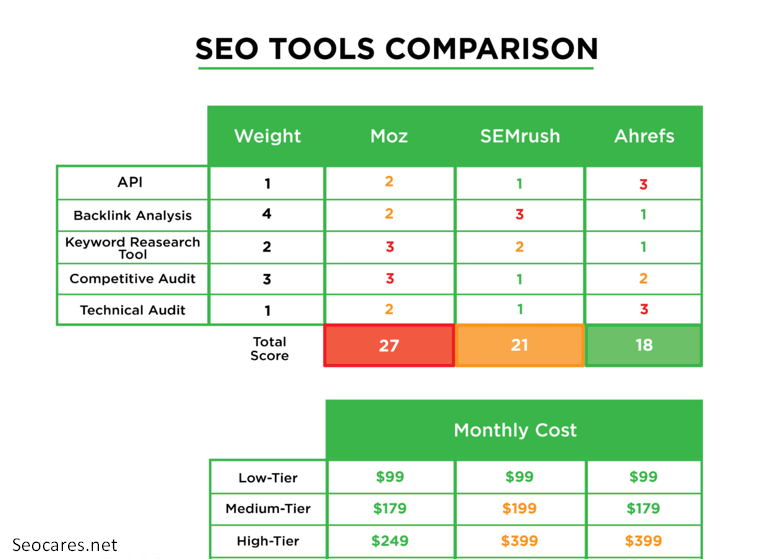
| Tool | Best For | Starting Price | AI Search Tracking | Content Writing |
| Semrush | All-in-one SEO platform | ~$140/mo | Yes (multiple platforms) | Basic |
| Surfer SEO | Content optimization at scale | ~$99/mo | Limited | Yes |
| Ahrefs | Keyword and backlink research | ~$29/mo | Yes (Brand Radar, 6 platforms) | Basic |
| Frase | Budget-friendly SEO + GEO | ~$39/mo | Yes (5 platforms) | Yes |
| Clearscope | Premium content grading | ~$129/mo | Limited (2 platforms) | No |
| Otterly.ai / Peec AI | Dedicated GEO tracking | ~$29–$89/mo | Yes (core focus) | No |
Pricing reflects publicly listed rates as of 2026 and can change; always confirm current pricing on the provider’s site before purchasing.
Pros and Cons Summary
Semrush
- ✅ Covers research, audits, and optimization in one platform
- ✅ Strong competitive intelligence data
- ❌ Higher price point than specialized tools
- ❌ Content optimization is less deep than dedicated tools
Surfer SEO
- ✅ Fast, precise content scoring
- ✅ Strong automation for refreshing old content
- ❌ Limited AI visibility tracking
- ❌ Not a full research suite on its own
Ahrefs
- ✅ Best-in-class keyword and backlink data
- ✅ Genuine, data-backed AI visibility tracking
- ❌ Learning curve for beginners
- ❌ AI features often require a higher tier
Frase
- ✅ Combines SEO and GEO scoring in one editor
- ✅ Very affordable for the feature set
- ❌ Interface less polished than premium competitors
- ❌ Smaller keyword database than Ahrefs or Semrush
Clearscope
- ✅ Extremely easy for writers to use
- ✅ Clean, trusted reporting
- ❌ Expensive relative to feature depth
- ❌ Weaker AI-search tracking than newer tools
How to Choose the Right Tool for Your Team

Don’t buy based on brand reputation alone. Match the tool to your actual bottleneck:
- If your bottleneck is research — you don’t know what to target — start with Ahrefs or Semrush.
- If your bottleneck is writing and optimizing content quickly, Surfer or Frase will save the most time.
- If your bottleneck is AI-search visibility, add a dedicated GEO tracker like Otterly or Peec AI rather than expecting your existing SEO tool to cover it fully.
- If you’re a solo creator or small team on a tight budget, Frase currently offers the strongest combination of price and capability.
Many established teams end up running two tools: one for research and technical health (Semrush or Ahrefs), and one for content optimization (Surfer, Frase, or Clearscope). That combination, while it means two subscriptions, consistently produces better results than trying to force one platform to do everything.
Frequently Asked Questions
1. What is the best AI SEO tool overall in 2026?
There isn’t one universal answer — it depends on your goal. Semrush is the strongest all-in-one platform for teams that want research, audits, and optimization together. Surfer SEO is the top pick specifically for content optimization.
2. Are AI SEO tools worth the cost for small businesses?
Yes, for most small businesses the time saved on keyword research and content structuring outweighs the monthly cost. Budget-friendly options like Frase make this accessible even on a tight marketing budget.
3. What is GEO, and do I need it?
GEO stands for Generative Engine Optimization — tracking and improving how your brand appears inside AI-generated answers on platforms like ChatGPT and Google AI Overviews. If your customers are likely to ask AI chatbots for recommendations, GEO tracking is increasingly important.
4. Can AI SEO tools write entire articles for me?
Some, like Frase and Surfer, include AI writing assistants that can draft content. However, published guidance from Google continues to emphasize helpful, people-first content, so AI drafts typically need human editing, fact-checking, and a genuine point of view before publishing.
5. How is Ahrefs different from Semrush?
Ahrefs is generally considered stronger for backlink and keyword data depth, while Semrush offers a broader all-in-one toolkit that includes more built-in content optimization and competitive intelligence features.
6. Do I need both a content optimization tool and a full SEO platform?
Not necessarily, but many growing teams use both — a research platform like Ahrefs or Semrush alongside a specialized optimization tool like Surfer or Frase — because each does its specific job better than an all-in-one solution.
7. What’s the cheapest AI SEO tool that still gets real results?
Frase is currently one of the most affordable options that still delivers solid content briefs, on-page scoring, and AI search tracking, starting around $39/month on annual billing.
8. Do AI SEO tools guarantee higher rankings?
No tool can guarantee rankings, since Google’s algorithm weighs hundreds of factors, including things outside any tool’s control, like backlink quality and site trust. These platforms improve your odds by removing guesswork, not by promising outcomes.
9. How often should I use these tools to update old content?
Most experts recommend reviewing high-value pages every three to six months, especially for competitive keywords where rankings shift often. Tools like Surfer’s Grow Flow can help flag pages that need a refresh automatically.
10. Is Clearscope worth the higher price compared to Frase?
It depends on team size and workflow. Clearscope’s simplicity suits editorial teams publishing 15+ articles monthly with dedicated writers. Smaller teams or solo creators usually get comparable value from Frase at a much lower price.
Conclusion
The AI SEO tools landscape in 2026 rewards teams that match the platform to the actual problem they’re solving, rather than chasing whichever tool trends on social media. Semrush and Ahrefs remain the strongest choices for research depth. Surfer, Frase, and Clearscope each handle content optimization differently, with Frase offering the best value for budget-conscious teams.
The bigger shift to watch is the rise of GEO. As more searches happen inside AI chatbots instead of traditional search boxes, tracking your brand’s visibility in those answers is quickly becoming as important as tracking your Google rankings. Whichever tool you choose, treat it as a starting point for smarter decisions — not a replacement for genuinely useful, well-researched content.